OVERVIEW:
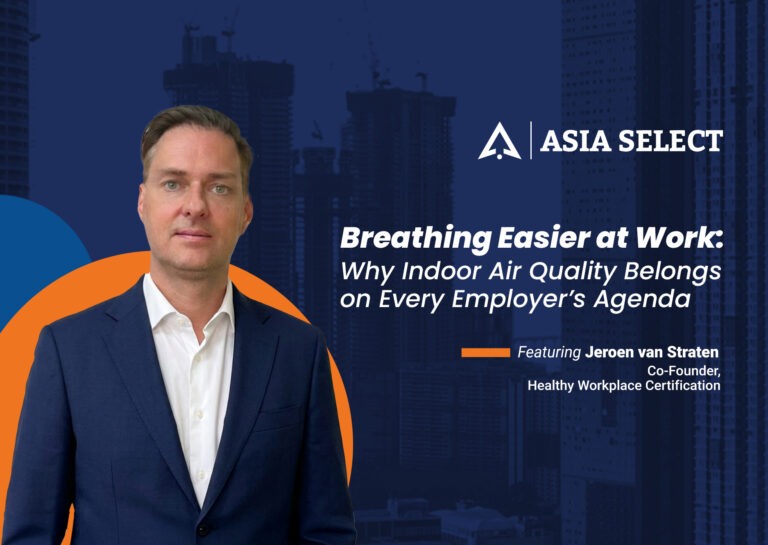
• Healthy Workplace Certification (HWC) co-founder Jeroen van Straten explains why indoor air quality (IAQ) deserves the same attention as workplace safety.
• Learn how the air inside an office can affect comfort, focus, and overall well-being.
• Explore how Indoor Air Quality (IAQ) data can support ESG reporting and help employers show they care.
• Discover how a Philippine-born certification is expanding to the Middle East, Singapore, and the UK.
Introduction
Employers invest in office design, benefits, and culture, yet the air employees breathe every day rarely gets the same attention.
Jeroen van Straten, co-founder of Healthy Workplace Certification, wants that to change. After a long career in the Indoor Air Quality (IAQ) industry, he and his team saw that air quality plays a real role in employee well-being, and they built a certification around that connection.
Why Indoor Air Matters
Most office workers spend a large part of their day indoors, where air quality depends on factors such as ventilation, airborne particles, humidity, and temperature. When these are poorly managed, people may feel stuffy, tired, or uncomfortable, and studies have linked poor indoor air to reduced focus and productivity. Good air quality doesn’t draw attention to itself, but employees tend to notice when it’s missing.
The topic is also drawing more attention in the Philippines. In September 2026, the Department of Labor and Employment issued an advisory asking private-sector employers to assess workers’ exposure to poor air quality using hazard identification and risk assessment procedures. The advisory deals with environmental air pollution, but it shows how air is increasingly treated as a workplace health concern.
Treating Air Quality Like Workplace Safety
Healthy Workplace Certification’s vision is for Indoor Air Quality (IAQ) to become as essential as workplace safety. Today, few employers would question the need for fire exits, safety training, or clear emergency procedures. They are simply part of running a responsible workplace. Healthy Workplace Certification believes air quality belongs in that same category.
The comparison holds up in three ways:
• Risk: Safety programs exist to catch problems before they harm people or disrupt the business. Air quality works the same way. Spotting a concern early is better than discovering it after employees have been uncomfortable or unwell for months.
• Reputation: A safe workplace tells clients, partners, and the public that an organization takes responsibility seriously. Healthy air sends a similar message, since it shows the organization looks after more than what is easy to see.
• Talent: Employees notice when their employer invests in their welfare, and people tend to stay where they feel valued. Clean, comfortable air is a quiet way of showing that care every day.
The difference is that air is invisible. A blocked exit is obvious, but poor air quality can go unnoticed while it affects how people feel and work. That is why certification matters: it gives organizations a clear way to look at what they can’t see and a standard to work toward.
The certification looks at how air quality affects:
• Comfort: How pleasant and easy it is to spend a full day in the space
• Performance: How well employees do their jobs
• Physical health: How people feel in their bodies, both during and after the workday
• Cognitive function: How clearly employees think, focus, and make decisions
• Productivity: How much people can accomplish with their time and energy.
Together, these show that air quality is part of the working conditions that help people do their best work.
A Global Ambition with a Philippine Start
Every big idea begins somewhere, and for Healthy Workplace Certification, that place is the Philippines. It was here that Jeroen and his team first asked how the air people breathe at work shapes the way they feel, and it was here that they set out to answer it.
Now, that idea is traveling. Healthy Workplace Certification’s first step beyond home is the Middle East, where it has just signed an agreement with a partner in Dubai who will take care of the region. It is a milestone for a certification that began in Philippine offices, built on the belief that employees deserve healthy places to work.
The journey has already reached further. Healthy Workplace Certification counts a few clients in Singapore and the UK, which shows that a simple, caring idea doesn’t stay local for long. Concern for employee well-being is felt in every country, and wherever a team spends its days, the people in it deserve to feel well.
“We’re going after the global market,” Jeroen says. For HWC, going global means more than growing a business. It means helping more people in more workplaces breathe a little easier, with a Philippine start behind it.
Interview Transcript
Jeroen van Straten, co-founder of Healthy Workplace Certification, shares how the certification began, why indoor air quality belongs alongside workplace safety, and where Healthy Workplace Certication is headed.
1. How did you start your career and lead the way to where you are now with Healthy Workplace Certification?
I’ve been in the industry with regarding to Indoor Air Quality for quite some time. And then we started to realize that Indoor Air Quality plays an important role into employee well-being. So we started to think, “How can we create a certification around Indoor Air Quality and how it impacts employee well-being? That’s how Healthy Workplace Certification was created.
2. Your vision in HWC includes making IAQ “as essential as workplace safety.” What parallels do you draw between safety compliance and IAQ certification in terms of risk, reputation, and talent?
We certify an organization on how air quality impacts our comfort, performance, physical health, cognitive function, and productivity. And our software provides also recommendations on how to improve indoor environment quality if a concern arises.
So clients can use our dashboard to take action if it is needed and extract reports that they can share with their internal organization how air quality is impacting employee well-being, including ESG report.
3. You’ve registered “Healthy Workplace Certified” as a trademark and positioned it as a recognized standard. What’s your strategy to make HWP the global benchmark that talent and investors actively look for?
We try to attack the global market with what we have created. Our first country that we’ve expanded to is the Middle East, to the region Middle East. We just signed an agreement together with a partner in Dubai that would take care of the Middle East Region. Because Healthy Workplace Certification was created and started here in the Philippines.
So we’re going after the global market. We have a few clients in Singapore and in the UK.
4. Looking 5 years out, what does success look like for HWP Certification in terms of workforce expectations, corporate behavior, and market standards?
Our goal would eventually be that when employees go for an interview to an organization, one of the questions will be, “Are you a Healthy Workplace Certified?”
Once we have reached that level, then we are going global.
Recap
Jeroen’s work points to a simple takeaway: the air inside a workplace is part of how employees feel, think, and perform.
As attention on workplace health grows and Environmental, Social, and Governance (ESG) reporting asks for measurable proof, organizations that measure and improve their indoor air quality will be better placed to attract talent and show stakeholders that they care.
Looking for more ideas on building a workplace where people want to stay? Browse our Hiring Page for fresh perspectives on workforce trends, hiring, and employee well-being in the Philippines.