OVERVIEW:
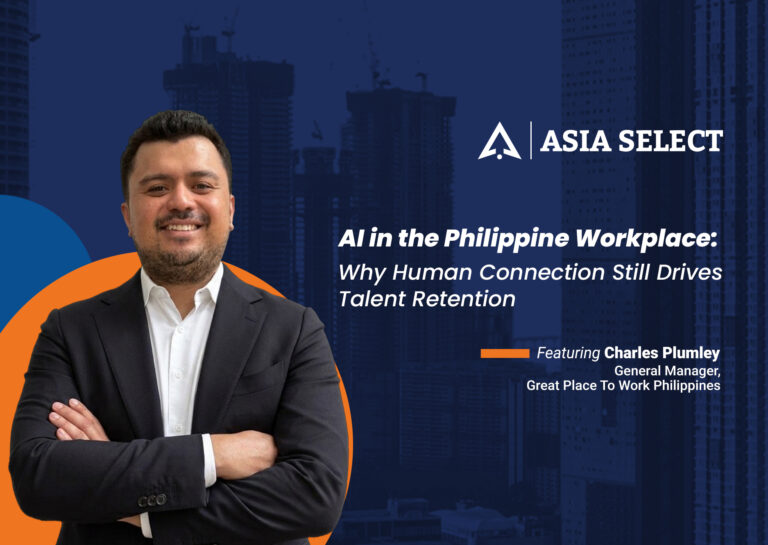
• Great Place To Work Philippines’ General Manager Charles Plumley explains why AI should augment human capability rather than replace employees.
• Explore how transparent communication and early employee involvement can support successful AI adoptio
• Learn how AI can reduce repetitive work while enabling employees to focus on more complex and meaningful tasks.
• Discover why human connection, workplace culture, and belonging will remain essential to attracting and retaining talent in the Philippines.
Introduction
Artificial intelligence is moving into Philippine workplaces faster than most HR strategies can keep up with. And according to Charles Plumley, General Manager of Great Place To Work Philippines, the companies that treat it as a replacement for people are already thinking about it wrong.
Speaking on the state of AI adoption, workforce sentiment, and the future of talent retention in the Philippines, Charles laid out a case for a different framing entirely: AI as augmentation, not automation. A tool that amplifies human capability rather than displacing it, especially in a services-driven economy like the Philippines.
From Hospitality to Leading Workplace Culture in the Philippines.
Charles’ career didn’t begin in HR or organizational strategy. It began in hospitality, working his way through his studies in the UK. That early experience taught him the value of money and hard work. From there, he moved into sales with a media company selling training services, eventually rising to become the company’s sales leader.
A personal milestone changed the trajectory of his career: meeting his now-wife, who was completing a master’s degree in the UK. To be closer to her as she prepared to move back to the Philippines, Charles relocated to Hong Kong, and eventually to the Philippines, where he took on the role of Area Manager at Expedia. He later became Head Manager for Zalora Philippines before joining Great Place To Work (GPTW) as General Manager. It’s a career shaped as much by relationships and adaptability as by ambition that echo throughout his views on the future of work.
Reframing AI as “Augmented Intelligence”.
Rather than treating AI purely as a labor-saving technology, Charles argues it should be understood as augmented intelligence. Something designed to help workers do their jobs better, not take their jobs away. He draws a simple analogy: AI is the car, but the human is still the driver. The technology is meant to work alongside people, not operate independently of them. This distinction matters most in a market like the Philippines, where the economy runs heavily on service industries built around human interaction. In that context, positioning AI as a collaborative tool rather than a threat becomes less of a communications tactic and more of a business necessity.
The Real Risk Isn’t AI. It’s How It’s Introduced.
For organizations rolling out AI tools, the biggest driver of employee anxiety isn’t the technology itself, but the way it’s introduced. Blindsiding employees, for instance, handing someone an AI agent and asking them to train it to take over their own role, creates fear and resistance almost immediately.
The alternative is early involvement. Framing AI adoption as an exploration employees are part of from the start, gathering their feedback, and giving them a genuine sense of being seen and heard significantly lowers that anxiety. Employees who feel consulted, rather than informed after the fact, are far more likely to engage with new tools productively instead of viewing them as a threat.
Communication about “why” AI is being adopted matters just as much as “how”. The instinctive public association between AI and job losses isn’t necessarily accurate. In practice, what’s unfolding across many Philippine workplaces looks more like AI absorbing repetitive, autonomous tasks, which in turn frees employees to focus on higher-value, more complex work and ultimately boosts overall productivity.
The Next Five Years: Winning Through Human Connection
Looking ahead, Charles believes the companies that will win on growth, talent, and resilience over the next five years will be those that adapt their policies to attract and retain the Philippines’ increasingly young workforce.
Even as automation and AI become more embedded in business operations, Plumley argues that the human element remains non-negotiable. A fully autonomous company, he notes, still needs people who want to work there and much of that desire comes down to connection: the friendships, relationships, and sense of belonging that a workplace provides.
Companies that recognize and invest in that human dimension, he says, will be the ones best positioned to attract and retain the next generation of talent.
Why Human Connection Will Outlast Automation?
Looking five years ahead, workforce composition is expected to be the real differentiator between companies that win on growth, talent, and resilience and those that don’t. As younger generations make up a growing share of the Philippine workforce, companies that adapt their policies to attract and retain this demographic are positioned to come out ahead. Even in a future shaped by automation, the human element remains difficult to engineer away. A fully autonomous company can still struggle to attract talent if it fails to offer what many workers are ultimately looking for: relationships, community, and a sense of belonging at work. Companies that recognize this, and build for it deliberately, are expected to have a durable edge in attracting and retaining the workforce of the future.
INTERVIEW TRANSCRIPT
Charles Plumley, General Manager of Great Place To Work Philippines, shares his perspective on how artificial intelligence is reshaping the workplace, strengthening organizational resilience, and responding to the evolving expectations of Filipino professionals and employers.
1. How did you start your career and lead the way to where you are now with Great Place To Work Philippines?
My career started in Hospitality. So when I graduated from college, I did what everybody does, and looks for work, right? I started in Hospitality when I got to the UK, so I worked my way through my studies. And that sort of taught me the value of money
and everything like that. So then, when I graduated, I got into sales where I worked for a media company selling training, rose up the ranks, and then became the sales leader there.
Then I met my now wife, who is in the UK on a master’s degree. And I moved to our Hongkong Office, to be closer to her, because she’s moving back to the Philippines. After that, I looked for work in the Philippines to be close to her and I got a job with Expedia as the Area Manager. After that I became the Head of Commercial for Zalora in the Philippines, and then now I’m at Great Place To Work.
2. You joined Great Place To Work Philippines as their General Manager in June 2025, right as hybrid work, AI, and multi‑generational tensions were accelerating. What did you see in the first 6–12 months that convinced you workforce preferences are now a core business advantage?
I think with AI, everyone sort of talks about it as “artificial intelligence”, right? In a country like ours, which is very service-industry driven. I prefer to look at it as “augment intelligence” because AI is there to sort of help us become better.
So if you take the analogy of an F1 car, right? AI is the car, but the driver is still human. It’s supposed to augment; it’s supposed to work together.
3. Many organizations are experimenting with AI. How can leaders use workforce preference data to design AI adoption that boosts performance instead of fueling anxiety and attrition?
Great question! I think it’s really important to understand the sentiment of your employees and getting them involved as soon possible. Because if you sort of tell them, “Hey, AI is coming. This is a tool we’re exploring. You try it out.” You know, get their feedback. Let them feel seen and heard. Involving them early in the process will reduce that anxiety.
If you suddenly tell someone, “Hey, here’s an AI agent that does your job. Can you teach it?” That’s obviously going to create a lot of anxiety. So, I think sort of involving them early in the process as soon as possible is important.
Additionally, it’s about communicating “why”, right? I think when people hear “AI”, they automatically think “job losses”, which is not necessarily the case, right? What we’re seeing here in the country right now is it’s probably replacing a lot more of the autonomous tasks but giving us a lot more freedom and time to do the more complicated tasks and be more productive.
4. Looking ahead in 5 years, which workforce preference trends in the Philippines do you expect to become the strongest predictors of which companies win on growth, talent, and resilience and why?
As I’ve mentioned earlier, the younger generations are only taking up more of the workforce now. So adapting those policies to suit that younger generation and attract them and retain them is going to decide what companies win.
Because at the end of the day, you could have a completely autonomous company, but you still need some element of people wanting to work there. So if you think about it, “Would someone like to work in a company where it’s full of computers?” You know what I mean? Because the other side of people don’t see when it comes to choosing where to work is the human connection, right?
So, people are going to want to work where they get to meet people, people want to work where they get to have friends, people want to work when they to do that. So, I think the companies that embrace that and know they need to attract and retain this demographic are the ones that are going to win.
Conclusion
As AI adoption accelerates across the Philippines, Charles’ insights point to a clear takeaway: technology alone won’t determine which companies thrive. The organizations that succeed will be the ones that introduce AI thoughtfully, involve employees early, and communicate openly about why these changes are happening.
At the same time, as younger generations reshape the workforce, human connection, culture, and a genuine sense of belonging remain just as critical to attracting and retaining top talent. Balancing innovation with people-first leadership isn’t just good practice, it’s quickly becoming a competitive advantage.
Want more insights like this? Visit our Hiring Advice page for expert guidance on recruitment, workforce trends, and building stronger teams in the Philippines.