OVERVIEW
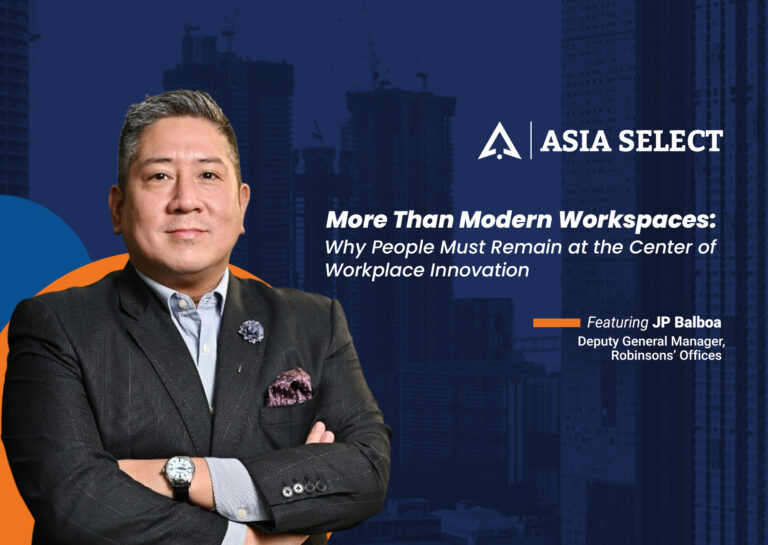
• Hear from JP Balboa, Deputy General Manager of Robinsons Land Corporation, on how his career journey and leadership experiences shaped his perspective on the future of work.
• Explore how sustainability, collaboration, and evolving workforce preferences are influencing the development of modern office spaces
• Understand why empathy and people-centered leadership remain essential in attracting, retaining, and developing talent.
• Discover why organizations that prioritize employee well-being and continuously adapt to people’s needs will be better positioned for long-term success
Introduction
As workforce expectations continue to evolve, organizations are rethinking what makes a workplace future-ready. Beyond modern facilities and technological advancements, businesses are recognizing the importance of creating environments that support collaboration, employee well-being, and meaningful professional experiences.
For JP Balboa, Deputy General Manager of Robinsons Land Corporation, this transformation reflects a growing understanding that successful workplaces must be built around the people who use them.
With 11 years of experience in the telecommunications industry and 15 years in real estate, JP has witnessed how business environments and workplace expectations have changed over time. Through his experience, he has seen how office developments have evolved from spaces primarily designed for operational efficiency into environments that consider sustainability, flexibility, and the overall employee experience.
His perspective highlights an important shift in the future of work: organizations must look beyond the spaces they build and consider the people whose lives and careers are shaped by them.
Redefining the Future-Ready Workplace
Having spent 15 years in real estate, JP has observed significant changes in how office buildings are designed and developed.
One notable shift is the growing importance of sustainability. Green building certifications and environmentally conscious features were once considered desirable additions to office developments. Today, these have increasingly become prerequisites for companies looking to occupy office spaces.
However, sustainability is only one aspect of what makes a workplace future-ready.
The pandemic also changed how employees experience the workplace. After several years of remote work, organizations now face a different challenge: giving employees meaningful reasons to return to the office.
For JP, this means creating spaces that encourage more than individual productivity. Modern offices must provide opportunities for collaboration, interaction, and connection.
Collaborative workspaces, green spaces, and thoughtfully designed amenities are becoming important considerations in developing office environments that respond to changing workforce preferences.
This shift reinforces the idea that a workplace should not simply accommodate employees. It should create an experience that makes them want to be there.
As organizations continue to adapt to new ways of working, office developments must also evolve to support the changing expectations of businesses and their people.
Why Empathy Matters in Leadership
While workplace design and technology play important roles in shaping employee experiences, JP believes that leadership remains a defining factor in an organization’s ability to attract and retain talent.
In an increasingly competitive talent landscape, businesses must give employees meaningful reasons to stay and perform at their best. For him, one of the most important ways leaders can do this is through empathy.
Organizations may invest in advanced software, establish comprehensive policies, and introduce workplace improvements. However, these efforts will have limited impact if employees do not feel understood and supported.
JP emphasizes that empathy must remain at the heart of the workplace experience. Employees who feel valued are more likely to develop stronger connections with their organizations and find greater motivation in their work.
This becomes particularly relevant as artificial intelligence and other technological advancements continue to transform business operations.
While technology can improve efficiency and introduce new ways of working, the human aspect of leadership must not be overlooked. Empathy should influence not only how leaders engage with their teams but also how organizations develop policies and make decisions that affect their employees.
For organizations seeking to remain competitive, understanding people is just as important as adopting new technologies.
Creating Workplaces That Prioritize People
Looking ahead, JP sees the development of future-ready workplaces as a continuous process. As workforce needs and expectations change, organizations must remain committed to improving the environments and experiences they provide.
One important development is the growing recognition of employee well-being, particularly the importance of addressing both physical and mental health.
This reflects a broader transformation in how organizations define an effective workplace. In the past, office planning often focused on maximizing space and accommodating as many employees as possible. Efficiency was largely associated with the number of workstations and the output they could generate.
Today, the conversation is shifting toward a more people-centered approach.
Rather than simply asking how many employees can fit into an office, organizations are beginning to consider how their spaces can better support the people who work in them.
This includes introducing meaningful amenities, improving workplace environments, and considering employee well-being as part of broader business decisions. This shift is essential to building organizations that can succeed in the long run. Those that continuously listen to their people and make improvements based on their needs will be better equipped to navigate the future of work.
Interview Transcript
In this interview, JP Balboa, Deputy General Manager of Robinsons Land Corporation, shares his career journey, insights on the evolution of office developments, and perspective on why empathy and people-centered leadership are essential to building future-ready workplaces.
1. How did you start your career and lead the way to where you are now with Robinsons Land Corporation?
Well, the first 11 years of my career was spent in the telecoms industry. So that’s where I acquired my account management and sales skills. But, the next 15 years were spent in real estate.
I was really fortunate to have a mentor, his name is Jericho Go. And he’s actually my boss until now. And through his leadership, I was able to develop my career in real estate.
And we’re very passionate about what we do in Robinsons Land because one of our advocacies is really keeping families together. So there’s so many overseas workers, people that go abroad, because there are no opportunities here.
So, what inspires us to do well in Robinsons Land is we want to create office buildings and developments that generate jobs here in the Philippines so that people don’t have to go abroad.
So, that really inspires us in the work that we do.
2. Robinsons Land has emphasized building future-ready workspaces. How do you define “future-ready” in a way that reflects changing workforce preferences?
Okay. So having been in the real estate industry for 15 years, we’ve seen how office buildings and developments have evolved. Before, companies would pursue green certifications. These are sustainable green building features.
Before, it was nice to have. But what we’ve noticed is, for the past five (5) years – maybe more – it’s becoming a prerequisite for tenants to occupy space. So moving forward, we pursue green building technologies.
And also, after the pandemic, we’ve noticed that the workplace now needs more areas for collaboration. I mean, we were working from home for 4 years. And now that we’ve unleashed the workforce back to the office, we have to give them a reason to want to go back to the office.
Hence, you need more amenities like collaborative work spaces, green spaces, and all of these design considerations help us plan for the new developments that we have in the office sector.
3. What role does leadership play in making sure workforce preferences are translated into actual business outcomes rather than remaining ideas on paper?
Okay. Well, I think that the race for talent is so competitive and you have to give your employees a reason for wanting to stay so that you can optimize performance. So I think being a leader, you give your co-workers and employees more of an incentive to stay if they feel that you have empathy.
I think if there’s one thing, you can implement the best software, have the best policies, but at the end of the day, at the heart of it all, if you don’t have empathy in the workplace, then you won’t be able to retain, attract, and grow talent.
So I think, with all the advancements now, with AI, it’s very important that you have empathy in the workplace, and it expands to your policies.
4. Looking ahead, what would a truly future-ready workplace look like for organizations that want to outperform by understanding their people better?
Well, I think it’s a process. Again, looking back – for the past 15 years – you constantly see an improvement. But one thing that I’ve noticed is that more and more companies are thinking about their people, right?
So, in the earlier discussions from the event today, we’ve noticed that there is a huge importance for health. Not just physical health, but mental health. So I think it’s going to be an ongoing process that never ends. Every year, there will be improvements. But at the heart of it is thinking about your people, right?
So introducing amenities that are for the people, whatever improvements there are, we will be more people-centric. Unlike in the olden days, where it’s all about efficiency. Squeezing as much square meters per person to make people fit, and have output based on the number of seats.
It’s now thinking about, “How do we take care of our people?”
And I think this is the trust that successful organizations are doing. So the organizations that think about their people will be the ones that will come on top.
Conclusion
JP Balboa’s perspective highlights a broader transformation in the future of work: successful workplaces must be designed not only around business requirements but also around the people who make organizations thrive.
Through sustainable developments, collaborative environments, and empathetic leadership, Robinsons Land Corporation demonstrates how workplace innovation can respond to changing workforce expectations while creating meaningful opportunities for Filipinos.
Want to stay ahead of the conversation? Explore our Hiring Page for more insights on recruitment, workforce trends, and building people-centered organizations.