Overview:
• Explore how IWG Philippines is helping businesses improve cost efficiency, strengthen resilience, and adapt to evolving workforce needs through flexible workspaces.
• Gain insights from Rowena Bravo-Natividad on the future of work, including hybrid models, work-near-home strategies, and the growth of hub-and-spoke workplaces.
• Discover how artificial intelligence, technology, and community-focused workspaces are creating more productive, connected, and employee-centered environments across the Philippines.
Introduction
The workplace is no longer defined by a single office, a fixed desk, or a daily commute to a central business district. As workforce expectations evolve and businesses navigate economic uncertainty, flexibility has become a strategic consideration. One that can influence cost efficiency, resilience, employee well-being, and growth.
For Rowena Natividad, Country Manager of IWG Philippines, this shift represents more than a change in where people work. It is an opportunity to rethink what the workplace can enable.
Body
As workforce expectations continue to evolve, organizations are reassessing how and where work is conducted. For IWG Philippines, workplace flexibility extends beyond providing access to multiple locations. It enables businesses to optimize costs, enhance resilience, promote employee well-being, and create new opportunities for sustainable growth.
With 52 locations across the Philippines, IWG is expanding access to flexible workspaces beyond traditional central business districts and bringing professional environments closer to where people live and work. This approach supports organizations seeking greater operational agility while addressing challenges such as lengthy commutes, business continuity and disaster recovery, and shifting workforce preferences.
From startups seeking a cost-efficient platform for establishing their presence to expanding companies entering new markets, flexible workspaces provide organizations with the scalability they need without the limitations of traditional long-term leases.
Beyond their functional benefits, IWG’s workspaces foster professional communities where individuals and organizations from diverse industries can connect, network, and collaborate. In doing so, they transform the workplace from a physical location into an environment that supports productivity, innovation, and business growth.
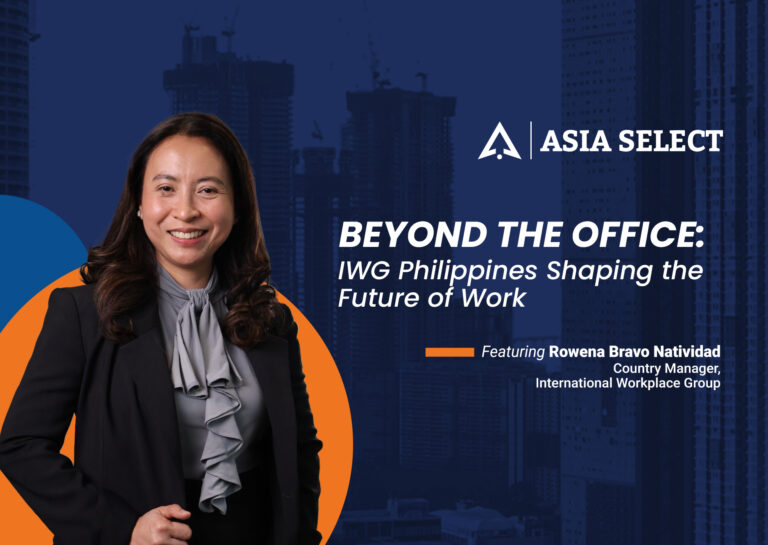
Rowena Bravo-Natividad, Country Manager of IWG Philippines, shares her perspective on how flexible workspaces are shaping the future of work, strengthening business resilience, and responding to the evolving needs of Filipino professionals and organizations.
Interview Transcript
1. In an article by BusinessWorld, you’ve said flexible workspaces are becoming a “survival strategy” rather than a luxury. How do IWG’s managed offices and virtual offices help companies turn workforce resilience into a competitive advantage during economic uncertainty?
Well, it’s more on the cost efficiency.
You know, during the pandemic, we’ve all been placed into a global working remote experiment. So, a lot of companies have actually been tied up to long-term leases and they’re not able to exit. They have to pay for the security deposit, for future of such, and then they have to pay for the remaining lease terms. So, it’s very challenging for them to manage the cost at the time.
Where flexible workspaces come in, we provide them with options that are very specific to their needs. For example, if they only need a business address, we can provide that to them. In case they need a three-seater office, we also have an availability for that. And if they decide to scale up their business, we can go to 10, 20, or more work stations. That gives them more breather in terms of cost, that’s where the cost efficiency comes in.
And for startup companies, you know how it is for them. They have to deliver certain milestones and, in their PNL, they’re very heavy on the real estate cost. That’s a big chunk of their cost. So they have to be very strategic about it, right? So, what do they usually do? They go to flexible workspace because they might get a membership for a start or a virtual office until such time that they’re ready to scale up their business. That’s when they get offices from us. That’s how we help the startup companies.
And you know what? It kind of amplifies their image as well because if they’re using our office, they get to carry our business address. Imagine if you have an “Ayala” address on your business card and then you present that to your potential investors and customers, that amplifies your image. That’s how we help the startup companies accelerate or incubate future business leaders within the community.
Another good benefit is the disaster recover or risk mitigation. As you know Philippines is very high prone to flooding, to earthquake, to multiple rallies. And there were some instances wherein particular employees wouldn’t be able to access their office, their building, because it’s flooded. So, they would have to reach out to a provider that can provide them immediate solution without disrupting their business. So, we offer that as well.
Here in the Philippines, we have 52 locations, at the moment, spread nationwide. So any of these customers can just call us and trigger the need for a disaster recovery site, and press so they have an office.
The idea, for these employees living in multiple locations, is to be able to access a location that’s very near their home. So that’s how we help these companies strategize, use flexibility as a strategy. So, it’s more of a risk mitigation and risk management for them beyond the usual property real estate cost.
2. How do you make sure that turning workforce preferences into a business advantage means more than just “more desks for more members,” and delivers deeper value like community, productivity services, and networking?
One of the very good benefits of working in a flexible workspace is you get to have an access in a community, because we house multiple tenants that are exposed in different kinds of industries and we would hold events on a weekly basis. That’s where they get to meet other employees of different companies.
So, these customers are actually getting offices from us in order for them to have access to this free networking event. That’s one of the value-add that we give. In majority of our startup companies or startup tenants, they consider that as a value-add to them because that’s an instant networking for them without having to go through other events. They just stay within the office and access the community event.
And aside from that, we also have the virtual office. If you want to enter the other markets within the Philippines and globally, you may easily do so with us. We can process that within a matter of an hour. So, that gives them an ease of doing business, that gives them a faster entry to different markets. For example, they want to expand in Davao. We have two sites in Davao, so we can easily provide them an office in Davao. So, it extends beyond the usual four-corner office. Y
You know, the offices, as we know it, are never the same. It has changed. And that’s where IWG is positioned well to capture or give these benefits to employees as well as to employers.
3. As someone who is shaping the future of work in the Philippines, what does your “ideal workplace of 2030” look like, and what one lesson would you share with other leaders?
Well, it’s happening now. In the past when we would talk about work, we would say, “The future of work is coming.” But it has happened now. It is happening now.
Pandemic has double-charged the demand for flexible workspace. But even prio to that, there’s been that need for more work-life balance. But then again, because we’re a multi-generational workforce, we have different definitions of a work-life balance.
I would say, 10 years from now, offices will be just everywhere. Productivity can be done just everywhere. It’s more of catering to employees’ well-being. And you know, the enemy in the Philippines is commute. So, one way going to the office would take you like 30 minutes to 1 hour. And there’s that study that says, “We lose around 3.4 billion pesos per day in terms of traffic. And five years from now, it would expound to 5.3 billion per day. So that’s how critical it is when it comes to managing this daily commute.
That’s why 10 years from now, we would see a lot of hub-and-spoke model. That’s why for IWG, we’ve tried to bring these workspaces very near where people live. And that will also help boost these local economies. So that’s where we would see a lot of 15-minute cities that are cropping up. A 15-minute city is defined as all amenities, offices, healthcare, flexible workspaces, hospitals can be accessed by walk or by bike within 15 minutes.
So that’s actually a concept by the French academe, Carlos Moreno, and we see that happening in the Philippines. A good example would be the townhouses. Not just in the CBD areas, but as well as outside of the CBD areas. And that capitalizes or underpins the national expansion plan for IWG.
So, we’ll see a lot more of these hub-and-spoke going forward and employees being measured on productivity in terms of the time they clock in.
4. As IWG Philippines’ Country Manager, how do you see evolving workforce preferences like hybrid, remote‑first, and “work‑near‑home”, directly shaping the kinds of flexible‑workspace solutions you’re investing in?
You know there’s that good combination of AI and flexible workspace. They kind of marry each other. So in the past, AI would just be an experimentation. But now, it’s usually embedded into the corporate world and into our daily lives, I must say.
I’d say, flexible workspace will continue to thrive and technology, AI, is the best enabler of this hybrid work while hybrid work accelerates adoption of the AI. So, they go handy together. It’s very important that, you know, AI does not just focus on automation, but how it can augment other processes such that it gives more time for high-value work.
We see a lot of this AI being embedded into hybrid, and I’ll be coming up an article that will talk about the Welltek. Because the tendency for hybrid workers is that they won’t be able to separate the borders between work and life, and then they get kind of burned out. And therefore, the rise of the buzz were called “quiet cracking”. So that means, they’re fundamentally unhappy, but they’re still being productive.
It actually brought to life another sector of the AI, which is called the Well technology or Welltek. So that means, there will be a lot of developments when it comes to innovation nooks that will give some neuron activation pods that will relieve people from stress. There will also be some micro farm, these are small plants that are based internally that would give an illusion that you are outside. Therefore, easing these employees from some of the stress that they are encountering at work. And there’s also that virtual skylight. This one is very interesting because if you’re working within an internal room, it will give an illusion that you are seeing a day light.
So, there’s a lot of ongoing development under the Welltek category that’s embedded into the workforce and pretty much works well with our hybrid work setup.
Recap
Rowena Bravo-Natividad’s perspective underscores a fundamental shift in how organizations approach the workplace. Flexibility is no longer limited to where employees work. It is increasingly becoming a strategic business capability that enables organizations to respond effectively to evolving operational and workforce needs.
As hybrid work, artificial intelligence, and employee well-being continue to reshape the modern workplace, IWG’s approach illustrates that the office of the future will not necessarily be defined by a single location. Instead, it will be shaped by flexibility, accessibility, resilience, and the ability to support employees and business operations wherever work takes place.
Stay informed about the latest insights on leadership, talent, and the future of work. Visit our Hiring Advice page to explore additional perspectives from industry leaders and business executives.