Overview
- Explore how Mondelēz International is redefining the snacking industry while building a people-first workplace culture.
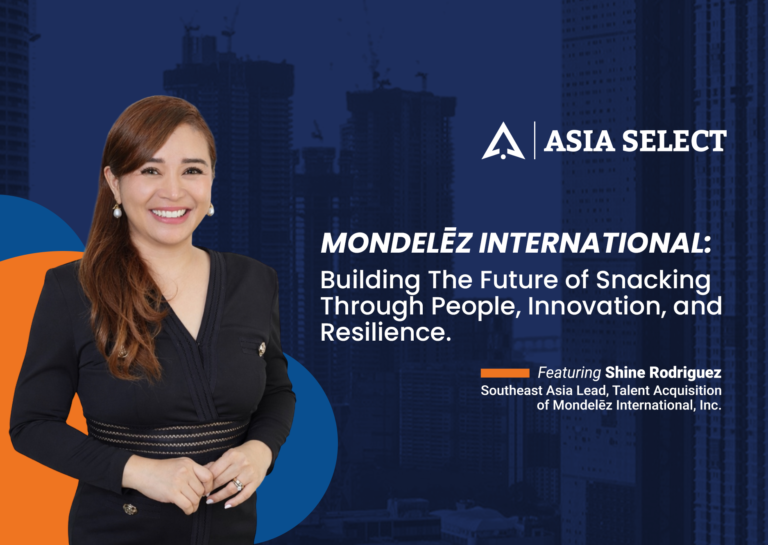
- Features Shine Rodriguez, Southeast Asia Lead of Talent Acquisition, who shares her personal roots and how Mondelēz wins the talent war in competitive markets.
- Shine’s strategic runway development initiatives cultivate “leaders of leaders, empowering talent to shine, advance, and mentor the next generation.
Introduction
Mondelēz International is leading the future of snacking through its diverse portfolio of biscuits, chocolates, candies, and beverages. Beyond creating well-loved brands, the company continues to reshape the future of snacking by creating a workplace that fosters inclusivity, sustainability, and innovation.
Recently recognized as a Global Top Employer for 2026 by Top Employers Institute and Great Place To Work Certified, Mondelēz International continues to demonstrate its unwavering commitment to fostering a “people-first” culture that empowers its four key pillars: Growth, Execution, Culture, and Sustainability.
With more than 80,000 employees across 150 countries worldwide, many would wonder how Mondelēz International achieved such global success. Behind its growth, however, the company faced the same critical workforce challenges that modern employers grapple with in today’s rapidly evolving workplace landscape. No success comes with obstacles, and Mondelēz continuously adapts its strategies to balance employee well-being, collaboration, innovation, and business performance across a diverse global workforce.
Shine Rodriguez, Southeast Asia Lead of Talent Acquisition in Mondelēz International, opens up to Asia Select about her personal roots and how the company is winning the talent war in one of the most competitive and dynamic regions by putting culture, flexibility, and purpose through her strategic runway development initiatives.
Interview Transcript
1. How did you start your career and lead the way to where you are now with Mondelēz International?
When I was in Grade 2, we had an assignment wherein we needed to bring a quote with us in school. I wrote something, as a Grade 2 student at that, and waited for my father.
So I presented it to my Papa, and I said, “Papa, Papa, look. This is what I will say in front of the class.” And it says, “Cleanliness is next to godliness.” Why is it that? Kasi mahaba. Because it was just long and I feel like I’m smart to say or to memorize a very long piece.
But my father wrote something in a piece of paper, and he told me to memorize it, bring it with me, and that is what I’m gonna say in front of the class. So the following day, I was called, “G3!” – Girl number 3. And I was asked, “Okay, so what’s your quote? Ganiyan.”
And I said, “It’s better to know where to go and yet not know how, than to know how to go and yet not know where.”
For a Grade 2 pupil, it took me hours to actually memorize that just to bring it in school.
Awa ng Diyos, my teacher did not understand it. Neither, I think, any of the Grade 2 pupils din, ‘no? I only understood it when I reached college.
So when I was in college, I actually planned to become a doctor. And I think a number of Filipinos are like that, ‘no? We plan really big for ourselves, and we work really towards the goal. What I have done is really work hard on my grades, etcetera. I was even part of the Student Council. I participated as a volunteer because philanthropy is really something that I really love. So that’s what I have done. And I pre-qualified for my desired school which is UP-PGH. I graduated cum laude and I was qualified for that.
However, my father got sick. And I think this is where my story in the corporate life started. It actually started with resilience. And that initial goal of knowing the profession I wanted changed too the life I want to give for my family.
So during that time, the rest of my classmates became lawyers. Well, most of them became doctors because we were pre-med. In fact, my husband is now a surgeon. We were classmates, so I met him in school.
And I told myself during that time na I would be betraying my age for this. Because at my time, there were just a handful of big multinational organizations. And during my time, the Top 2 multinational organizations were Procter and Gamble, and Unilever.
And I said, “If I will not be a doctor, I would be part of either of those organizations. And I was offered by both, and I took Unilever.
So when I was in Unilever, this is where I deliberately learned to actually design development plans. And that development plan is something that I have been working on until now. But versus in the past, wherein in my career, I’ve started–of course, being a young professional at that–I started designing my own development plan.
But now, what I have brought with me is designing runways for the people around me, for my team. And ensuring that I don’t just create stars, but I create leaders of leaders.
2. Mondelēz has built a strong portfolio of well-loved brands over the years. Internally, how do you ensure the employee experience authentically reflects the company’s culture and values?
The biggest brands that we have would be Oreo, Cadbury, Toblerone, and I’m so sure those brands you are very much aware of. But for me, the biggest brand that we really have is our employees. And I think how we have translated this authentically in our organization is we live by the values that we have. Most especially, for me, it’s doing what is right.
So first, we will listen to our people. We have surveys year-round to understand, not just the buzz of the people, but really to see how we can act on those. And act on a timely manner at that.
Number two, it’s really putting into mind the employee experience at that. So a translation of that would not just be us getting the latest technology just because we want to be called, you know, as a future-forward employer.
But at the heart of it, we look at the employee experience. How can we take out, you know, the stress or unnecessary steps, bureaucratic steps, that our employees would need to go through for simple tasks. That’s why we bring in technology.
And number three, I think it’s really the community that we have. We have been certified as a Top Employer across Southeast Asia in different markets at that. We have also been certified as a Great Place To Work. And honestly, we went through that process of getting certified, especially for Top Employers, not because we want it as an employer brand badge. But we want to acid test the policies that we have, the practices that we have if it’s actually the best practice that is present in the industry.
Not just for us to be seen as a good employer, but most especially for us to know if we are really catering to the experience of the employees within the organization.
3. How did you scale a leadership program at Mondelēz to develop “leaders of leaders” while navigating intense competition in the snacking industry?
In the snacking industry or food manufacturing industry at that, our competitors would always want to have the biggest market share. And I think not just our competitors, but also us. And as all of us would want to have the biggest market share, it is also true that we want the biggest and the best talents, you know, fit for the future vision of the organization.
So for me, what I have done as a leader across Southeast Asia is not just to design what would be perhaps the next task or the next role for a person. But it is really designing a runway for each of the team members that we have, ensuring that I create stars within the organization.
And how have I done it?
First and foremost, for me, it’s really understanding what are the strengths of your people. And not just hearing them out, it’s really knowing it by heart.
So if you tell me, if you ask me, or if you give me a name of one of my team members across Southeast Asia, I can clearly enumerate in a split second the strengths of that person, achievements of that person. I need to know that by heart and, at the same time, know by heart their aspirations. What is it that they want?
I am not the type of leader who would dictate that this is, you know, the track for you. I want to understand what your strengths are and what you are happy about.
What is it that you would want to look forward to? What is your biggest why? What are your aspirations, not just just for yourself in the professional aspect, but also in personal.
I marry that together to the third pillar, which is understanding what is the vision of the business. Because I align the strengths and aspirations of my people to the business objectives to give them a platform where they can shine.
And that for me is creating a runway.
Because even if you develop your people, even if you know their strengths, even if they work hard to the task that you give them, but if you don’t give them enough exposure, then what they do is actually contributing greatly to the business objectives, then they won’t have a runway.
So it is very important for the leader, and this is something I remind myself every day, to really understand what is the business objective, where is the business heading, so that I can align the strengths and aspirations of my people to those business objectives.
At the end of the day for me, what I want to achieve is a win-win situation.
The business wins, my people win.
Quick Recap
Shine proves that strong workplace culture is not just a perk, it’s a strategic driver of innovation and growth. By investing in resilience, inclusivity, and deliberate talent development, Mondelēz International continues to build the future of snacking while creating a workplace where its people can truly thrive across diverse markets and generations.
Looking to stay ahead in today’s competitive job market? Discover more expert insights from industry-leading executives by visiting our Hiring Advice page.